

Roofing Durability & Exposure Challenge
Roofing assemblies face extreme thermal expansion and contraction cycles, with surface temperatures shifting from chilly nights to over 70°C in the summer. This induces massive mechanical stress on waterproofing membranes, leading to crack propagation at joints and concrete interfaces. Additionally, ponding water behind parapets and UV radiation deteriorate standard bituminous materials, causing premature failure. Specifiers must design assemblies that accommodate structural movement and resist UV degradation.
Application Selection Guidance
Select Geobit APP or SBS modified bituminous membranes for traditional built-up protected roofs where physical damage from traffic or gravel ballast is expected. For roofs with complex geometry, multiple pipe penetrations, or HVAC equipment stands, specify Geobit liquid-applied polyurethane (PU) or hybrid polyurea membranes. These form a monolithic, seamless barrier that eliminates lap joints. Ensure appropriate primers are applied based on substrate moisture levels, and always verify that fall-to-drain gradients are minimum 1:80.
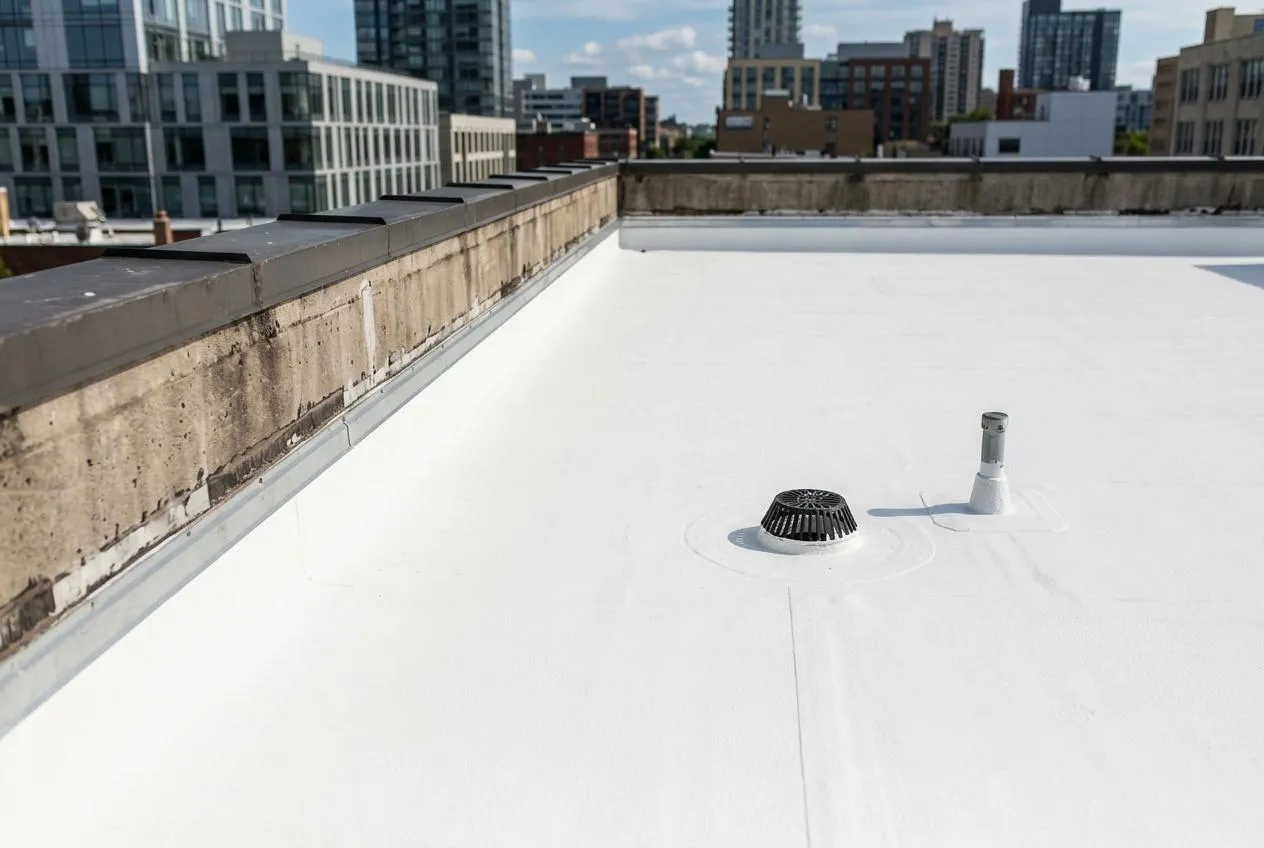
Apply Geobit high-penetration bitumen primer followed by torch-applied APP or SBS modified bitumen waterproofing membranes (Betoflex 4P/5P or 4S/5S, 4mm-5mm thick) with 80mm side laps. Protect the cured membrane assembly using semi-flexible asphaltic or polypropylene protection boards (Betoboard / Betostick PB) prior to backfilling or screed placement.
Apply thixotropic SBS rubberized bitumen emulsion (Betocoat RBE series) in 2 continuous coats (min 1.5mm DFT) for damp-proofing foundation slabs and protected roof decks prior to placing thermal insulation and ballast.
Apply single-component or 2-part elastomeric polyurethane liquid membrane (Betocoat PU) or elastomeric acrylic coating (Betoroof 6000 / Betotherm AC) around roof penetrations, upstands, HVAC equipment curbs, and complex roof geometries for seamless joint-free encapsulation.
Formulate screeds and slope renders using polymer bonding admixtures (Betobond SBR / AC) to improve compressive strength, adhesion, and moisture resistance.
Spray rigid closed-cell polyurethane foam (Polybetol 40-50kg/m³) or lay XPS thermal insulation boards (Betoboard EXP) to achieve required R-value insulation performance and thermal protection.
Seal expansion joints, parapet flashings, and perimeter terminations with high-movement single-component polyurethane joint sealant (Betoseal 1PU, movement +/-25%) or 2-part polysulfide sealant (Betoseal PS PG).
Install non-woven needle-punched polyester geotextile filter fabric (Betotec 120-1000 GSM) as a protective cushion and drainage filtration layer above waterproofing membranes and under ballast.
Incorporate continuous bitumen-impregnated fiber joint filler board (Betocell) in structural movement joints to absorb thermal expansion and structural movement.
Spray pure elastomeric polyurea coating system (100% solids, rapid curing <10 seconds) for heavy-duty commercial roofs, bridge decks, and high-traffic deck applications.
Evidence & Case Studies
Specification Hubs
Matching System Products & Functional Roles
APP Modified Bitumen Membrane - Plain & Mineral-Surfaced
HDPE Pre-Applied Waterproofing Membrane
Self-Adhesive Waterproofing Membrane
Request a system specification for your project
Request a direct calculation, material sample board, typical submittals, or project design validation for this assembly.
Request Technical Assistance